
Converting a property? You may only need to pay 5% VAT
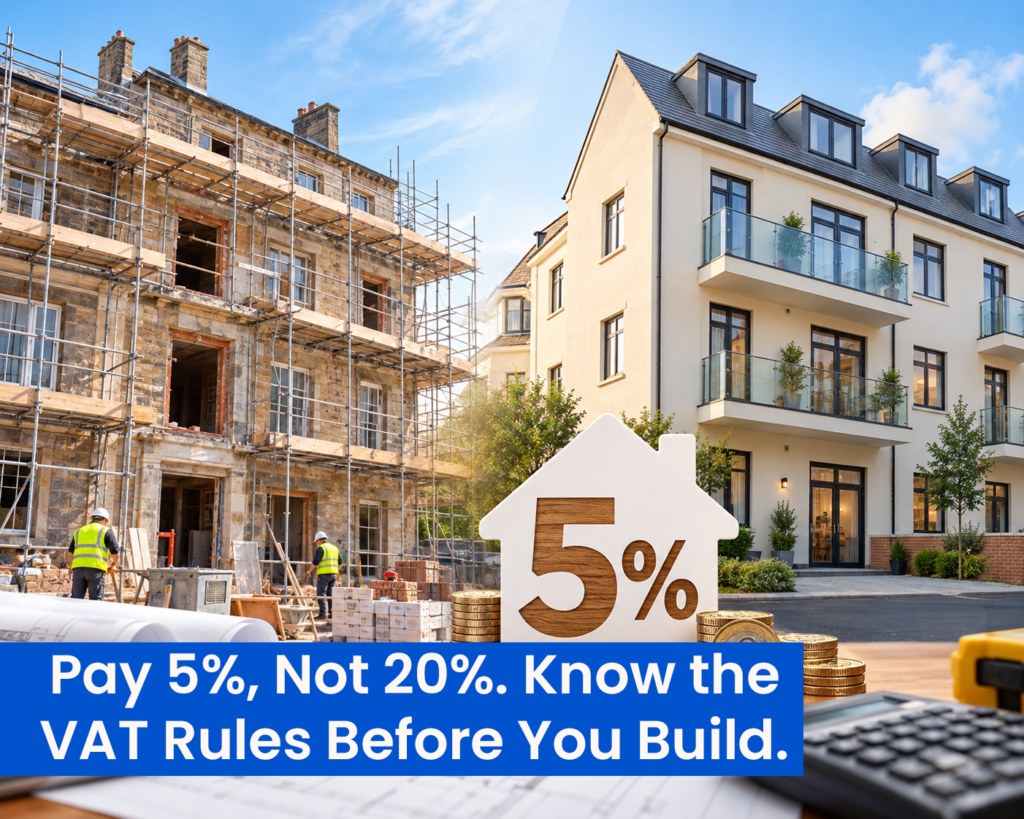
Building work on an existing property is normally charged at the standard VAT rate of 20%. But if the work converts a building into homes, or changes the number of homes in it, your builder may be able to charge just 5%.
On a large project, that difference can save thousands of pounds. It only applies if the right conditions are met, so it is worth checking before work starts and before you agree a price.
This update is for property investors, landlords, developers and builders. It is based on HMRC guidance in VAT Notice 708, section 7.
What counts as a qualifying conversion
The 5% rate can apply when the work creates one of these:
- A different number of self-contained homes. For example, splitting one house into flats, or merging flats into fewer, larger units.
- Homes from a building that was never lived in. For example, turning an office block, shop or barn into flats or a house.
- A house in multiple occupation (HMO), such as bedsits, from a building that had no HMO in it before. For example, a family house or care home turned into bedsits.
- A building used solely for a relevant residential purpose, such as a care home or student accommodation, from a building not last used for that purpose.
It can also cover:
- A former home that was fully adapted to another use, such as offices or a dental practice, being turned back into a home
- Staff accommodation that is not self-contained, such as rooms above a pub, being turned into a self-contained flat
All three of these must be true for the 5% rate to apply:
- The work is a qualifying conversion
- Where needed, the builder holds a valid certificate from you
- The services being supplied are qualifying services (see below)
What does not qualify
These projects usually stay at 20%:
- Renovating or extending a house that stays as one house
- Adding a “granny annexe” that is not a separate, self-contained home
- Adding extra bedrooms to an existing bedsit property or care home
- Remodelling an existing care home, or converting outbuildings into extra rooms for it
- Refurbishing a flat above a shop that was just used for storage, without being formally adapted to another use
On that last point, if the flat has been empty for 2 years or more, a separate 5% rate for empty homes may apply instead. Ask us and we will check.
Mixed projects: only the conversion part gets 5%
HMRC looks at each part of a building separately. Only the part where the number of homes changes gets the reduced rate. General refurbishment elsewhere in the same building stays at 20%.
Example based on HMRC guidance: a block has 4 floors with 4 flats on each floor (16 flats).
| What happens | VAT rate |
|---|---|
| A lift is installed and flats on floors 0 to 2 are reshaped around it, still 4 flats per floor | 20% |
| Top floor goes from 4 flats to 3 penthouses | 5% on the top floor work |
| Top floor: 2 flats merged into 1, the other 2 just refurbished | 5% on the merge only |
| Ground floor goes from 4 flats to 5, while top floor goes from 4 to 3 (still 16 in total) | 5% on both floors |
The last row matters. Even when the total number of homes in the building stays the same, each part that changes can still qualify.
If a builder’s invoice covers both qualifying and non qualifying work, the charge can be split on a fair and reasonable basis. If no split is made, the whole invoice must be charged at 20%.
Which costs get 5% and which stay at 20%
Even on a qualifying conversion, not every cost gets the reduced rate.
| 5% VAT | 20% VAT |
|---|---|
| Building work and installing building materials | Carpets and fitted bedroom furniture |
| Repairs, maintenance and redecoration done during the conversion | Scaffolding (putting up and taking down) |
| Improvements such as extensions or double glazing | Hire of equipment or goods |
| On site work for water, power, heat and access | Landscaping |
| On site drainage, security and waste disposal | Architects, surveyors, consultants and project supervisors |
Tip: ask your builder to show 5% and 20% items on separate lines of the invoice. It makes the VAT easier to check and easier to defend if HMRC asks.
Garages, planning and building control
Garages. These can also get 5%:
- Turning an outbuilding into a garage
- Building a new detached garage
- Building a drive to that garage
This only works if the garage will be used with the new home, and the work is done at the same time as the conversion. A hardstanding (parking area) only qualifies if it is also used as an access.
Planning and building control. If the work needs planning permission or building control approval and it has not been granted, the whole job is charged at 20%. Make sure approvals are in place before work starts.
Disclaimer:
The 5% VAT rate applies only to qualifying conversions and specific conditions. Please refer to HMRC VAT Notice 708, Section 7, or seek professional advice.