With continued economic pressure affecting many sectors, unpaid customer invoices are becoming an increasing concern for businesses. For businesses taxed on an accrual basis, where income is taxed when invoiced rather than when payment is received — bad debt relief can provide valuable tax and VAT relief when debts become irrecoverable.
This article outlines the key conditions for claiming relief and the evidence businesses should retain to support claims.
Direct Tax Relief for Bad Debts
Businesses may claim relief against income tax or corporation tax for qualifying bad debts in the accounting period in which the debt is written off.
To qualify for relief, the following conditions must be met:
- The debt must have arisen wholly and exclusively for the purposes of the trade.
- The income must previously have been included in turnover.
- The debt must be specifically identified — general provisions or estimates do not qualify.
- The debt must be written off as irrecoverable in the accounting records.
This relief is particularly relevant for companies and unincorporated traders operating above the £150,000 turnover threshold who are not using the cash basis.
VAT Bad Debt Relief
Separate rules apply for VAT purposes. Businesses can reclaim the VAT element of unpaid invoices by including the amount in Box 4 (input tax) of the VAT return, provided certain conditions are satisfied.
Conditions for VAT Relief
The business must ensure that:
- The invoice is more than six months overdue.
- The debt has been written off in the accounting records.
- The debt has not been sold, factored, or assigned under a valid legal assignment.
A common misunderstanding is the timing of the six-month rule. The period begins from the payment due date, not the invoice date.
Example
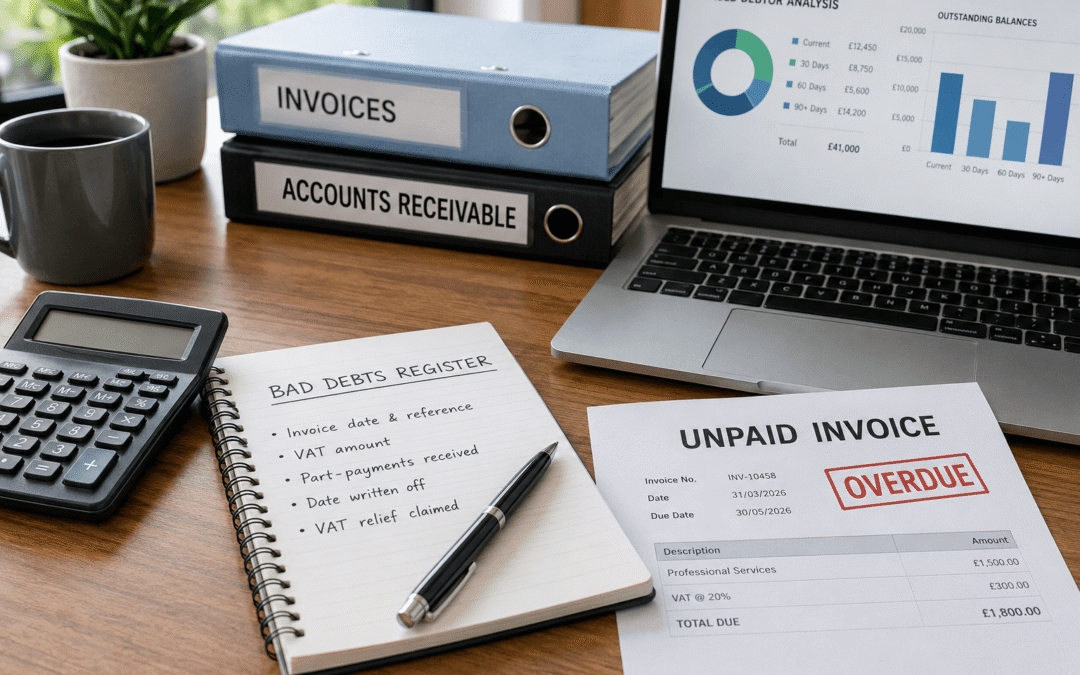
If an invoice is issued on 31 March 2026 with 60-day payment terms, payment falls due on 30 May 2026. The earliest VAT bad debt relief claim date would therefore be 30 November 2026.
Maintaining Proper Records
Businesses should maintain a dedicated bad debts register containing:
- Original invoice dates and references
- VAT amounts charged
- Details of any part-payments received
- Dates debts were written off
- Details of VAT bad debt relief claims made
Accurate documentation will be critical if HMRC reviews the claim.
Demonstrating That a Debt Is Irrecoverable
HMRC will usually examine whether a debt is genuinely irrecoverable or simply overdue.
Businesses must be able to demonstrate that reasonable recovery action has been taken before relief is claimed.
What constitutes “reasonable” depends on the circumstances and value of the debt:
For smaller debts:
- Reminder letters
- Telephone follow-ups
- Formal payment demands
For larger or material debts:
- Use of debt collection agencies
- Solicitor involvement
- Legal proceedings
Evidence of these actions should be retained.
Debts Older Than Four Years
VAT bad debt relief is generally time-barred once a debt becomes more than four years old.
However, in some cases, businesses may still obtain VAT relief through a “Regulation 38” adjustment where there has been an agreed change in consideration between the parties.
Examples include:
- Goods returned under hire-purchase or lease agreements
- Customers becoming entitled to contingent discounts
- Defective goods leading to a negotiated price reduction
In these cases, the supplier issues a credit note and adjusts the Box 1 (output tax) figure on the next VAT return.
Importantly, there is no time limit for a Regulation 38 adjustment. Therefore, while a five-year-old invoice may be out of time for VAT bad debt relief, it may still be corrected through a valid credit note where the circumstances allow.
Final Thoughts
Bad debt relief can provide valuable support for businesses experiencing customer payment difficulties, but claims must be carefully documented and supported by evidence that the debt is genuinely irrecoverable.
Businesses should regularly review aged debtor balances, maintain detailed records, and ensure debts are formally written off in the accounting records before making claims for either direct tax or VAT relief.
Disclaimer:
This newsletter is intended for general information purposes only and does not constitute tax, legal, or accounting advice. Businesses should seek professional advice before making any claims or decisions based on the information provided.