What Employers Need to Collect Before Processing Payroll
When a new employee joins a business, there are two important compliance processes that employers should complete before the first payroll is processed:
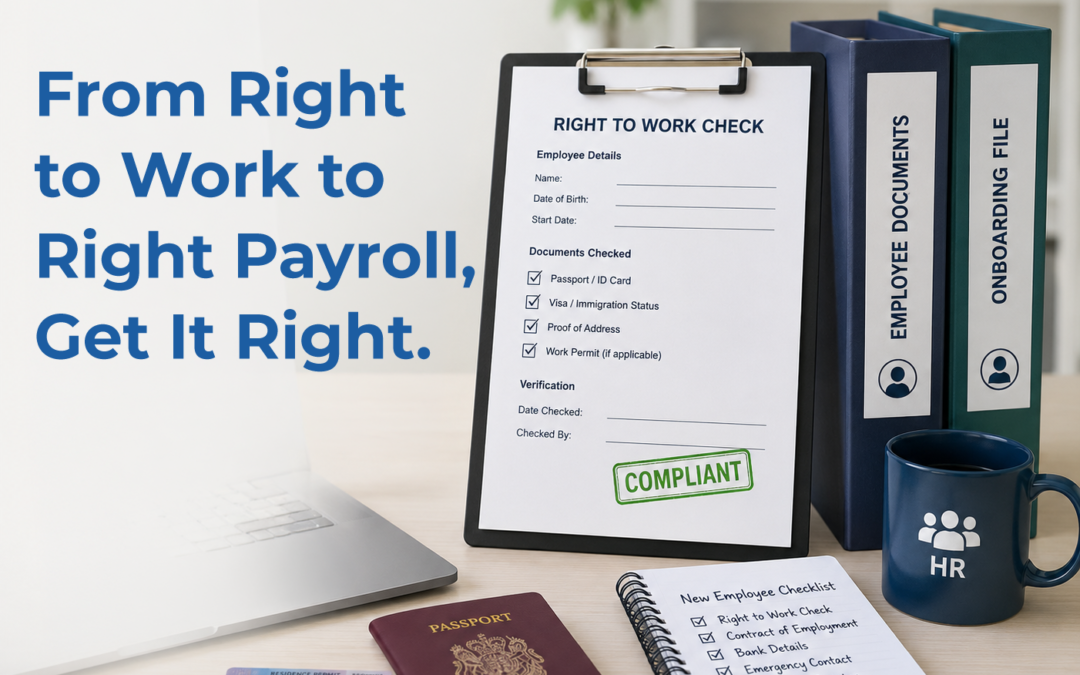
Establish the employee’s Right to Work in the UK; and
Collect the correct information required to set the employee up on payroll.
These are separate requirements. A passport, visa or Right to Work share code does not, by itself, provide all the information required to operate PAYE correctly.
Having a standard new-employee checklist can help employers avoid payroll errors, incorrect tax codes, missed RTI information and Right to Work compliance issues.
1. Right to Work – What Employers Must Do
Employers have a legal responsibility to ensure that employees have the right to work in the UK.
The Right to Work check should normally be completed before the employee starts work. A properly completed check can provide the employer with a statutory excuse against a civil penalty if the individual is subsequently found to be working illegally.
Importantly, employers should carry out Right to Work checks consistently and should not only check individuals who appear to be foreign nationals or migrants. The Home Office specifically warns employers against discrimination when carrying out these checks. (GOV.UK)
2. How Can an Employee Prove Their Right to Work?
There are three main routes, depending on the employee’s circumstances.
A. Home Office Online Right to Work Check
Where the employee has digital immigration status, they can generally provide a Right to
Work share code.
The employer should:
- Obtain the employee’s share code;
- Obtain the employee’s date of birth;
- Use the employer’s Home Office online checking service;
- Confirm that the employee is permitted to work;
- Check any restrictions on the type of work or hours;
- Confirm that the photograph relates to the person presenting themselves; and
- Save the online profile/check result as evidence.
The employee’s share code for Right to Work purposes begins with “W” and is valid for 90 calendar days. The employer must use the employer-side Home Office service; simply viewing information shown to the employee is not sufficient.
B. Manual Document Check
Where a manual check is permitted, the employer should obtain the appropriate original acceptable documents.
The employer must:
- Obtain the relevant documents.
- Check that the documents appear genuine and have not been altered.
- Confirm that the documents belong to the employee.
- Check the photograph and date of birth.
- Confirm that the individual is permitted to undertake the work being offered.
- Make and securely retain copies.
- Record the date on which the check was completed. (GOV.UK)
The Home Office’s acceptable-document lists distinguish between individuals with a continuous right to work and those with a time-limited right to work.
C. Digital Identity Verification
For certain British and Irish citizens with valid passports, employers may be able to use an approved Identity Service Provider (IDSP) to conduct a digital identity verification check.
The employer should retain the required evidence of the check.
3. Important – Do Not Accept an Old BRP as a Right to Work Document
Biometric Residence Permits (BRPs) are no longer issued by the Home Office as the normal means of proving immigration status.
Where an employee has digital immigration status, employers should generally use the appropriate Home Office online Right to Work service and share code rather than asking for a physical BRP.
4. What Documents Should the Employer Collect for Right to Work?
Depending on the employee’s circumstances, the employer may need:
For an employee proving status online
- Right to Work share code
- Employee’s date of birth
- Home Office online Right to Work check result
- Evidence of any work restrictions
- Follow-up check date, where applicable
For a manual check
The employer should obtain the relevant acceptable original document(s) from the Home Office’s prescribed list.
Examples can include:
- British passport
- Irish passport/passport card
- Certain immigration documents
- Certain passports containing appropriate Home Office endorsements
- Other documents specified in the Home Office acceptable-document lists
Employers should not create their own list of acceptable documents. The current Home Office guidance should be followed because the acceptable-document rules can change.
5. Time-Limited Right to Work – Don’t Miss the Follow-Up Check
Some employees will have temporary or time-limited right to work.
In these cases, the employer should record the date on which the next check is required and carry out the follow-up check at the appropriate time.
For example, an employee may have immigration permission that expires after a specified period.
The employer should therefore maintain a diary or HR system alert for:
Visa/permission expiry → Follow-up Right to Work check → Evidence retained
Failure to carry out the required follow-up check can result in the employer losing its statutory excuse.
Disclaimer: This content is provided for general information only and does not constitute legal, immigration, tax or payroll advice. Right to Work and PAYE requirements can change. Employers should refer to the latest GOV.UK guidance or seek professional advice before taking action.